

Turmus Ayya
Turmus Ayya | |
|---|---|
| Arabic transcription(s) | |
| • Arabic | ترمسعيّا |
| • Latin | Turmus'ayyeh (official) Tourmous Ayyeh (unofficial) |
| [mapframe not available on SimWiki] Interactive map of Turmus Ayya | |
| Coordinates: 32°02′09″N 35°17′10″E / 32.03583°N 35.28611°E | |
| Palestine grid | 177/160 |
| State | File:Flag of Palestine.svg State of Palestine |
| Governorate | Ramallah and al-Bireh |
| Founded | Circa 800 BCE |
| Government | |
| • Type | Village council |
| • Head of village council | Yaser Alkam[1] |
| Area | |
• Total | 17.6 km2 (6.8 sq mi) |
| Population (2017)[2] | |
• Total | 2,464 |
| • Density | 140/km2 (363/sq mi) |
| Name meaning | Thormasia[3] |

Turmus Ayya (Arabic: ترمسعيّا) is a Palestinian town in the Ramallah and al-Bireh Governorate of the West Bank. The Palestinian Central Bureau of Statistics recorded 2,464 residents in 2017.[2] Many of the town's residents hold United States citizenship. The American Friends Service Committee estimated that more than 80% of residents held U.S. citizenship in 2023.[4] while Ynetnews reported a figure of more than 90%, citing the mayor.[5] The Guardian reported in August 2026 that about 80% of residents were U.S. citizens from New York, Chicago, and Paterson, often returning to the town during the summer.[1]
Families from Turmus Ayya established businesses in the United States and Latin America in the 1960s, and later returned and invested money into local economy. Recent developments include agriculture infrastructure, date processing factories, construction, and equestrianism. [5][6]
Turmus Ayya also hosts the Hugo Chavez Ophthalmic Hospital, a government hospital that specializes in eye care, and the only Ophthalmic hospital in the West Bank.[7]
The town has repeatedly been impacted by Israeli settler violence.[8][9] Major incidents include the June 2023 terror attack which led to the murder of resident and father of two, Omar Qattin, and the murder of 14-year-old U.S. Citizen, Amer Rabea, in April 2025.
Etymology
The Applied Research Institute–Jerusalem (ARIJ) cites Palestinian historian Mustafa Murad al-Dabbagh's interpretation of Thormasia as a likley origin. Al-Dabbagh describes Thormasia as an Aramaic words associated with a mountain, remains from pressed grapes, and ruin or desolation.[10]
Adolf Neubauer proposed another theory. He suggested the town is related to Thormasia, a place mentioned in the Talmud.[11][12] Michael Avi-Yonah and Shemuel Yeivin proposed identifying Turmus Ayya with Tur Shimon, which is mentioned in rabbinic literature as having been destroyed during the Bar Kokhba revolt.[13][14]
Another proposed explanation connects "Turmus" with the Latin word thermae, meaning a public bath. Under this interpretation, the settlement was originally called Ayya, with "Turmus" added after the construction of a bath during the Roman or Byzantine period.[15]
Geography
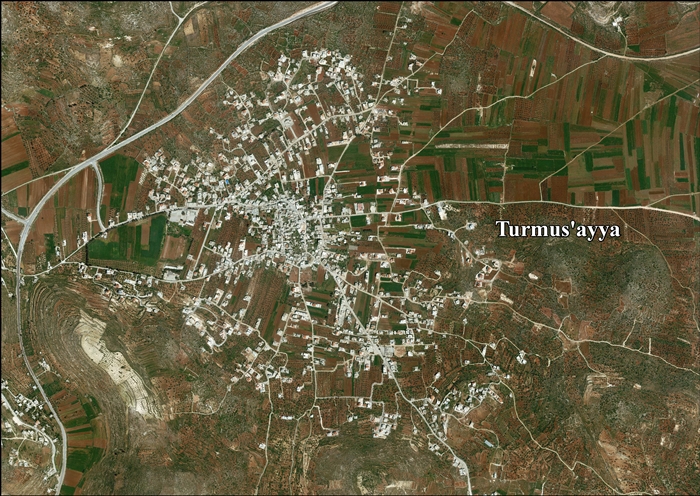
Turmus Ayya is about 22 kilometres (14 mi) northeast of Ramallah. Nearby Palestinian communities include Sinjil and Khirbet Abu Falah. The Israeli settlement of Shilo lies to the east. The town has an area of approximately 17,606 dunams, or 17.6 square kilometres.[10] Its elevation is about 720 metres above sea level.
History
Potsherds dating to the late Iron Age around the 8th–7th centuries BCE and later periods have been found in Turmus Ayya. Archaeological surveys have suggested that settlement at the site continued from that period onwards.[16]
Turmus Ayya is generally identified with Turbasaim in Crusader sources.[17] Northeast of the town is Khirbet Ras ad-Deir, also known as Deir el-Fikia, which has been identified with the Crusader village of Dere.[18][19]
In 1145, half of the income from Turmus Ayya and Dere was assigned to the Abbey of Mount Tabor for maintenance of the church at Sinjil.[20] In 1175, Turmus Ayya, Dere and Sinjil were transferred to the Church of the Holy Sepulchre.[21]
Ottoman era
Turmus Ayya was incorporated into the Ottoman Empire with the rest of Palestine in 1517. In the 1596 tax registers it appeared in the Nahiya of Quds in the Liwa of Quds. The village had 43 households, all Muslim. Residents paid taxes on wheat, barley, olive trees, vineyards, fruit trees, goats, and beehives, amounting to 7,200 akçe. Eleven twenty-fourths of the revenue went to a Waqf.[22]
In 1838, Edward Robinson placed Turmus Aya in the province of Jerusalem, close to the boundary with the province of Nablus.[23] He described it as being on a low rocky mound in a level valley.[24]
Several graves in the town's cemetery have headstones dating to the Ottoman period.[citation needed]
French explorer Victor Guérin visited Turmus Ayya in 1870. He recorded ancient cisterns, a broken lintel decorated with a garland, and fragments of a column.[25] Guérin estimated the population at about 700. He wrote that the village was administered by two sheikhs and that water was brought from nearby springs because its cisterns were almost dry.[26]
An Ottoman village list from around 1870 recorded 88 houses and 301 male residents.[27] Hartmann later recorded 82 houses.[28]
In 1882, the Palestine Exploration Fund's Survey of Western Palestine described Turmus Ayya as a moderately sized village on a low knoll in a fertile plain, with a spring to the south and fruit trees around it.[12] In 1896, its population was estimated at about 834.[29]
British Mandate era
In the 1922 census of Palestine, conducted by the British Mandate authorities, Turmus Ayya had 707 residents, all Muslim.[30]
The 1931 census of Palestine recorded 185 occupied houses and a population of 717, including 716 Muslims and one Christian woman.[31]
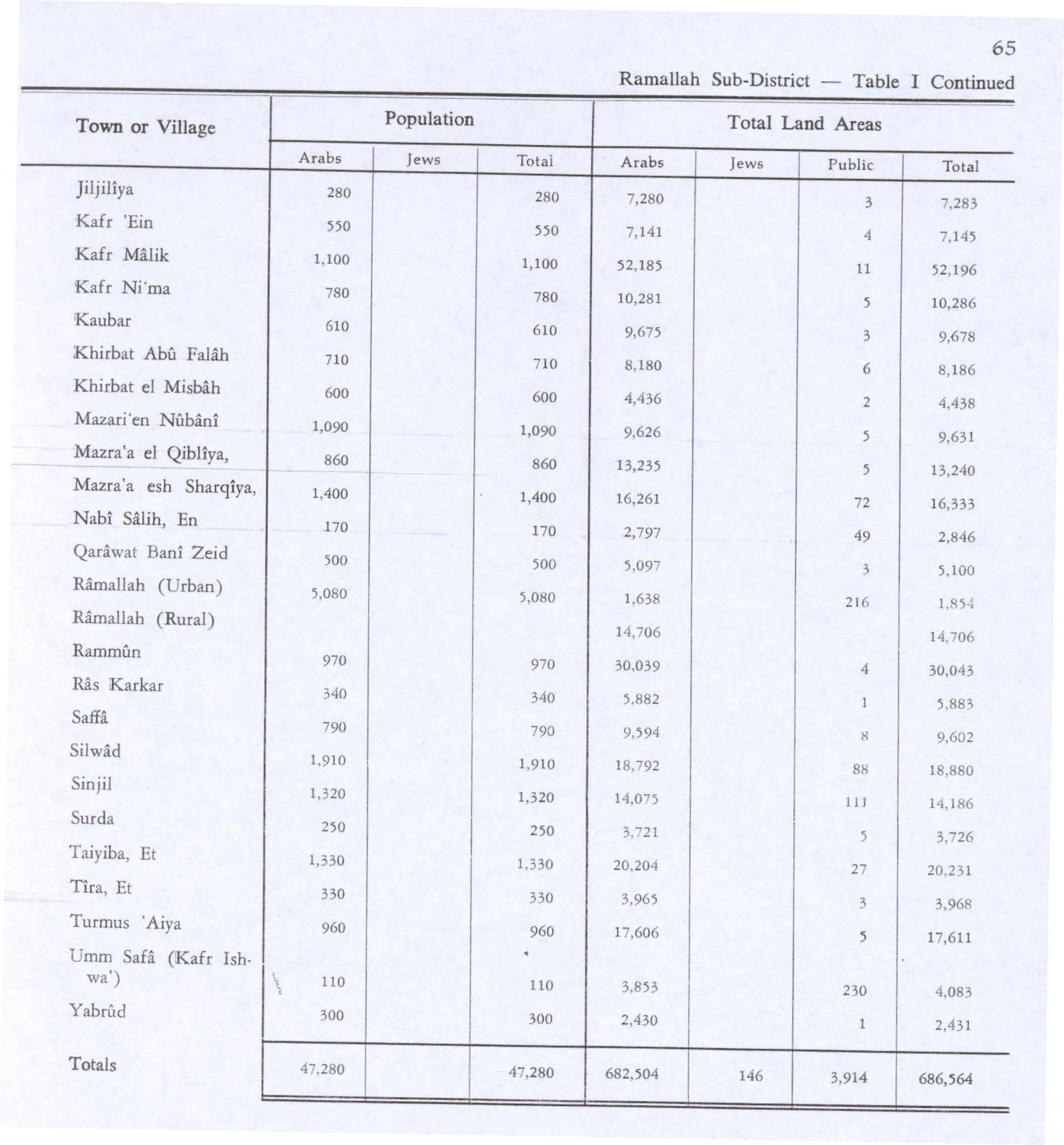
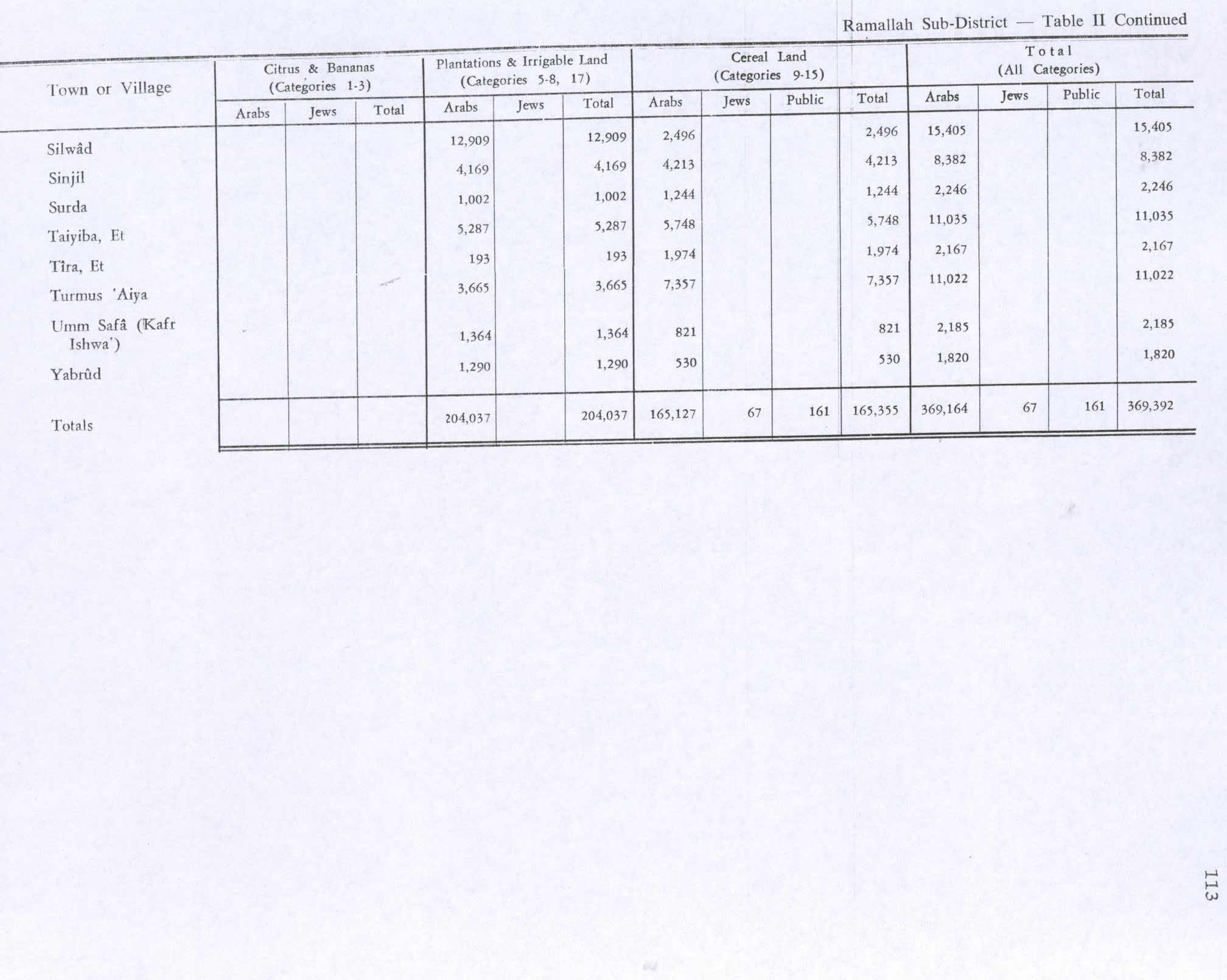
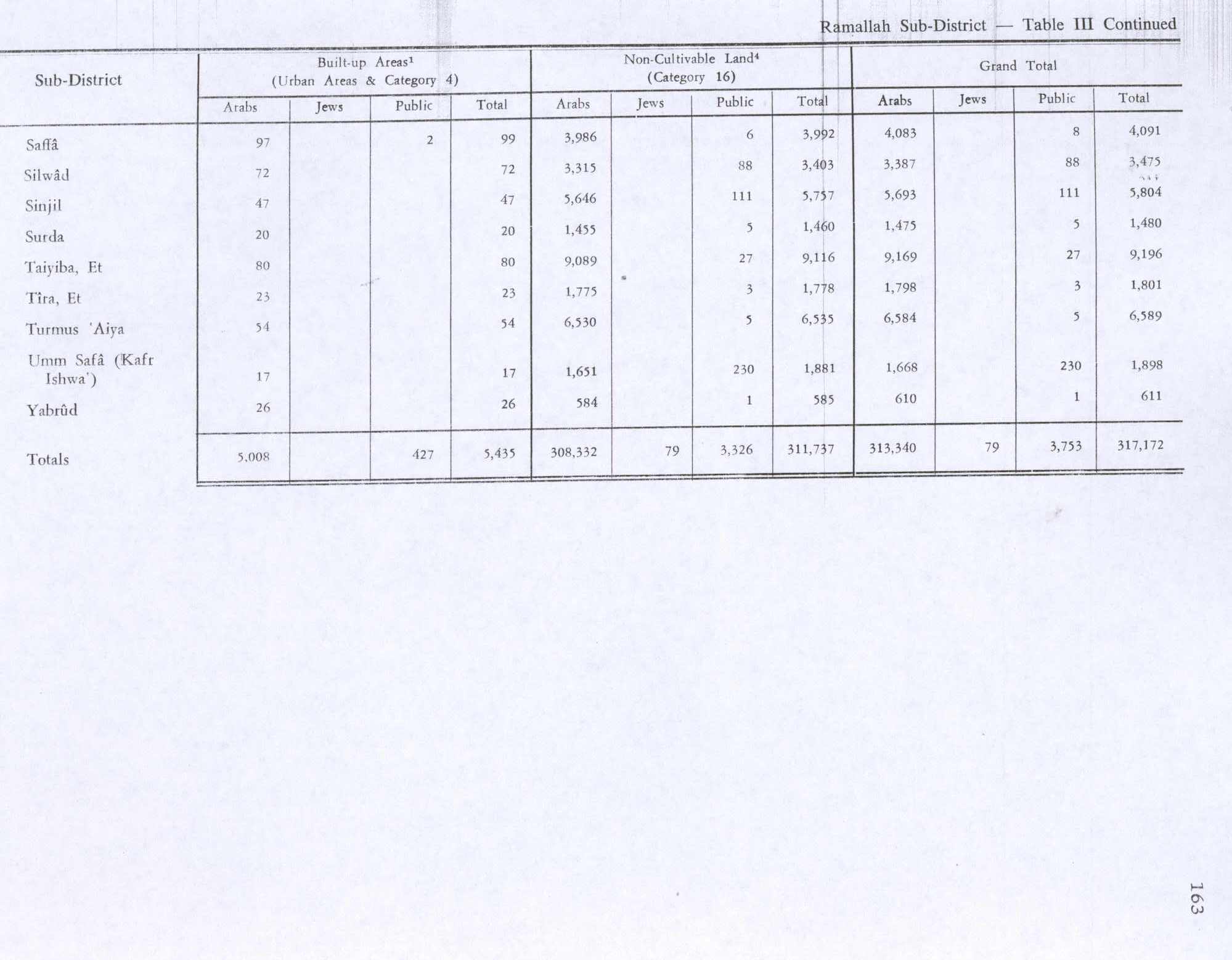
In the 1945 village statistics, Turmus Ayya had a population of 960, all Muslim, and a total land area of 17,611 dunams.[32][33] Of this land, 3,665 dunams were plantations or irrigable land, 7,357 were used for cereals and 54 dunams were classified as built-up area.[34][35]
Jordanian era
After the 1948 Arab–Israeli War and the 1949 Armistice Agreements, Turmus Ayya came under Jordanian rule. Jordan annexed the West Bank in 1950.
The Jordanian census of 1961 recorded 1,620 residents.[36]
1967–present
Since the Six-Day War in 1967, Turmus Ayya has been under Israeli occupation. An Israeli census that year recorded 1,562 residents. By 1989, the population had risen to 5,140.[citation needed]
Under the Oslo II Accord of 1995, 64.7% of the town's land was classified as Area B and 35.3% as Area C.[37] ARIJ reports that 752 dunams of village land were taken for the Israeli settlement of Shilo and another 372 dunams for Mizpe Rahel.[38]
In December 2014, Palestinian official Ziad Abu Ein died during a protest near Turmus Ayya against Israeli occupation and land confiscation.[39]
Settler violence
B'Tselem recorded ten attacks by Israeli settlers in or around Turmus Ayya during the first six months of 2023.[40]
On 21 June 2023, hundreds of masked Israeli settlers entered Turmus Ayya after four Israelis were killed in a shooting near the settlement of Eli. None of Turmus Ayya's residents had any apparent connection to the earlier shooting. About 30 Palestinian houses and 60 vehicles were set on fire during the attack. The attacks lasted two hour and resulted in millions of shekels of damages[41][42] Omar Qattin, a 27-year-old resident, was shot dead during the attack.[43][44]
An Israel Defense Forces spokesperson described the settler attacks as acts of terror by criminals.[9][8] In the following weeks, five suspects in settler riots were placed in Israeli administrative detention.[45]
In July 2024, the United Nations Office for the Coordination of Humanitarian Affairs reported four consecutive days in which settlers burned farmhouses and agricultural generators around Turmus Ayya.[46]
On 4 April 2025, Israeli forces shot and killed 14-year-old Palestinian-American Amer Mohammed Rabea near Turmus Ayya and wounded two other teenagers.[47] The IDF claimed the three had thrown rocks at a road and described them as terrorists. It released thermal footage of the shooting and said Unit 636 had killed one and hit two others.[48]
Later that month, settlers began establishing an unauthorized outpost near Turmus Ayya, throwing rocks, firing live rounds, and decending upon the inhabitants living on the outskirts. Footage published by the Israeli organization Yesh Din showed construction equipment and mobile homes being moved into the area while Israeli soldiers were present. The Times of Israel reported that the Israeli government had not formally authorized a settlement at the site.[49]
On 18 August 2025, masked settlers attacked Palestinian farmland near Turmus Ayya, damaged olive trees and set vegetation on fire. A BBC crew at the scene reported that settlers riding quad bikes chased people attempting to put out fires on the affected land.[50]
On 19 October 2025, settlers attacked Palestinians harvesting olives near Turmus Ayya. Vehicles were burned and several farmers were assaulted. A masked settler struck a 55-year-old woman in the head; she lost consciousness and was hospitalized with a brain hemorrhage. U.S. journalist Jasper Nathaniel filmed part of the attack.[51][52][53][54]
On 6 January 2026, settlers cut a water pipeline serving homes on the outskirts of Turmus Ayya and redirected the water toward a nearby outpost's swimming pool, according to OCHA. The agency reported that seven households containing 31 people, including 13 children, were affected and relied on local wells afterward.[55]
In August 2026, The Guardian reported that another unauthorized Israeli outpost had been established on private farmland owned by people from Turmus Ayya, and settlers had carried out repeated nighttime incursions near the town, throwing rocks and firing live rounds. Residents interviewed by the newspaper described gunfire, threats and attacks on houses, and some had installed shutters, fences or barbed wire around their properties.[1]
Yaser Alkam, the head of the village council, told The Guardian that he regularly contacted the U.S. embassy during attacks. He said embassy officials had intervened in late July 2026 after Israeli soldiers occupied a house belonging to a U.S. citizen from Syracuse, New York. The U.S. State Department told the newspaper that U.S. citizens in the West Bank had access to consular services and said it condemned violence by any party.[1]
Infrastructure
Healthcare
In 2018, the Hugo Chavez Ophthalmic Hospital opened in Turmus Ayya. It was the first Palestinian government hospital specializing in eye care.[7]
The hospital has four floors and an area of around 7,300 square metres. Its facilities include outpatient clinics, an emergency room, operating rooms, a cornea bank, administrative offices, and accommodation for medical staff. An adjacent building hossts lecture halls and meeting rooms, a cafeteria, and other support facilities. The complex also has an on-site wastewater treatment system.[56]
During the COVID-19 pandemic, the hospital was temporarily converted into a treatment and isolation center for patients from the Ramallah district.[57]
Economy
Turmus Ayya's economy has heavy ties to the United States.
Many families from Turmus Ayya emigrated during the 1960s and 1970 to the United States and Panama. Most established businesses abroad and later returned to the town and maintained vacation homes there. Others established remote business and moved back to the town permanently, often building large houses. Money earned abroad finances the construction of these luxury homes, which led to a continued boom in local construction and tile-based businesses. [5][6] Ynetnews reported in 2023 that local residents sometimes refer to Turmus Ayya as the "eastern suburb of Washington, D.C." because of its large Palestinian-American population.[5]
Reports by Le Monde detail large investments by diaspora families into town infrastructure and other projects in Turmus Ayya beyond homes.[6] Agricultural infrastructure and automations funded by the diaspora consists most of the local economy.[58][59] An AFP report published by The Times of Israel features businessman Jamal Zaglul, a Palestinian-American who returned to Turmus Ayya to operate an olive press in the town.[60] This also attracts labour from surrounding villages as agricultural workers work on land belonging to Turmus Ayya residents. [61]
Beyond agriculture, there are recent developments that diversify the economy. One such project includes the Turmus Aya Equestrian Club, which was founded in 2007 by Ashraf Rabi. His family had emigrated to Panama and the United States in the 1980s before returning to Turmus Ayya in the early 2000s. The club includes riding and equestrian facilities for breeds of rare Arabian horses, and attracts horse traders from all over the Middle East [62][1]
References
- ↑ 1.0 1.1 1.2 1.3 1.4 Roth, Andrew; Taha, Sufian (3 August 2026). "Abandoned by the US: Palestinian Americans trapped in a surge of Israeli settler violence". The Guardian. Retrieved 12 August 2026.
- ↑ 2.0 2.1 Preliminary Results of the Population, Housing and Establishments Census, 2017 (PDF). Palestinian Central Bureau of Statistics (PCBS) (Report). State of Palestine. February 2018. pp. 64–82. Retrieved 24 October 2023.
- ↑ Palmer, 1881, p. 246
- ↑ "The U.S. must pressure Israel to stop settler violence against Palestinians". American Friends Service Committee. 26 June 2023. Retrieved 26 November 2025.
- ↑ 5.0 5.1 5.2 5.3 Halabi, Einav (25 June 2023). "West Bank Palestinian village rampaged by settlers is 90% American". Ynetnews. Retrieved 26 November 2025.
- ↑ 6.0 6.1 6.2 Mehl, Sandra (27 September 2025). "En Cisjordanie, le village des Américains oubliés de la Palestine". Le Monde (in français). Retrieved 10 August 2026.
- ↑ 7.0 7.1 "The Hugo Chavez Hospital Opens Next Month". Middle East Monitor. 1 October 2018. Retrieved 15 March 2025.
- ↑ 8.0 8.1 "IDF spokesman slams settler riots that 'create terror'; far-right MK: It was a protest". Times of Israel. 22 June 2023. Retrieved 23 September 2023.
- ↑ 9.0 9.1 "20 Countries Rail at Israel for Settler Mob Attacks on Palestinians, IDF Condemns as 'Terror'". Haaretz. Retrieved 23 September 2023.
- ↑ 10.0 10.1 "Turmus'ayya Town Profile" (PDF). The Applied Research Institute – Jerusalem. 2012.
- ↑ Neubauer, 1868, p. 279
- ↑ 12.0 12.1 Conder and Kitchener, 1882, SWP II, p. 292
- ↑ Yeivin, S. (1946). "The Bar-Kokhba War". Jerusalem. pp. 92–94. (Hebrew)
- ↑ Avi-Yonah, Michael (1976). "Gazetteer of Roman Palestine". Qedem. 5: 102. ISSN 0333-5844. JSTOR 43587090.
- ↑ Zissu, Boaz (2008). "The Hellenistic Fortress at Ḥorvat Tura and the Identification of Tur Shimon". Israel Exploration Journal. 58 (2): 171–194. ISSN 0021-2059. JSTOR 27927203.
- ↑ Finkelstein, 1997, pp. 651–652
- ↑ Röhricht, 1887, p. 206; cited in Finkelstein, 1997, p. 651
- ↑ Conder and Kitchener, 1882, SWP II, p. 331
- ↑ Pringle, 1993, p. 196
- ↑ Röhricht, 1893, RHH, p. 59, No. 234; cited in Pringle, 1993, p. 196
- ↑ Röhricht, 1893, RHH, p. 141, No. 529; cited in Pringle, 1993, p. 196
- ↑ Hütteroth and Abdulfattah, 1977, p. 113.
- ↑ Robinson and Smith, 1841, vol. 3, p. 83
- ↑ Robinson and Smith, 1841, vol. 3, p. 85
- ↑ Guérin, 1875, p. 28, as translated in Conder and Kitchener, 1882, SWP II, p. 378
- ↑ Guérin, 1875, p. 28
- ↑ Socin, 1879, p. 162. It was located in the Beni Murra district.
- ↑ Hartmann, 1883, p. 115
- ↑ Schick, 1896, p. 122
- ↑ Barron, 1923, Table VII, Sub-district of Ramallah, p. 17
- ↑ Mills, 1932, p. 51.
- ↑ Government of Palestine, Department of Statistics, 1945, p. 26
- ↑ Government of Palestine, Department of Statistics. Village Statistics, April, 1945. Quoted in Hadawi, 1970, p. 65
- ↑ Government of Palestine, Department of Statistics. Village Statistics, April, 1945. Quoted in Hadawi, 1970, p. 113
- ↑ Government of Palestine, Department of Statistics. Village Statistics, April, 1945. Quoted in Hadawi, 1970, p. 163
- ↑ Government of Jordan, Department of Statistics, 1964, p. 24
- ↑ Applied Research Institute–Jerusalem, Turmus’ayya Town Profile, p. 16.
- ↑ Applied Research Institute–Jerusalem, Turmus’ayya Town Profile, p. 17.
- ↑ "Death in the olive groves". The Economist. ISSN 0013-0613. Retrieved 20 August 2024.
- ↑ "Settler Violence = State Violence | Turmusaya". B'Tselem. Archived from the original on 5 February 2024. Retrieved 20 August 2024.
- ↑ Serhan, Yasmeen (22 June 2023). "The Palestinian Town Attacked by Israeli Settlers Is Reeling". Time. Retrieved 18 August 2024.
- ↑ Halabi, Einav; Ben Kimon, Elisha (21 June 2023). "Hundreds of rampaging settlers burn homes, cars in Turmus Ayya". Ynetnews. Retrieved 20 August 2024.
- ↑ Ziv, Oren (23 June 2023). "'Our taxes in the U.S. are being used to kill us here'". +972 Magazine. Retrieved 18 August 2024.
- ↑ Goldstein, Eric (27 July 2023). "Israel Settlers Rampage in Palestinian-Americans' West Bank Hometown". Human Rights Watch. Retrieved 20 August 2024.
- ↑ "5th suspect placed under administrative detention over settler riots last month". Times of Israel. 10 July 2023. Retrieved 18 August 2024.
- ↑ "Humanitarian Situation Update #189 | West Bank". United Nations Office for the Coordination of Humanitarian Affairs. 10 July 2024. Retrieved 18 August 2024.
- ↑ "Palestinian-US teen killed by Israeli forces in occupied West Bank". Al Jazeera. 6 April 2025. Retrieved 7 April 2025.
- ↑ "Teen killed in West Bank while throwing stones was US citizen, Palestinian officials say". Times of Israel. 6 April 2025. Retrieved 7 April 2025.
- ↑ Yohanan, Nurit (19 April 2025). "Settlers filmed establishing new illegal outpost in West Bank under IDF protection". The Times of Israel. Retrieved 12 August 2026.
- ↑ "BBC witnesses Israeli settlers' attack on Palestinian farm in West Bank". BBC News. 18 August 2025. Retrieved 18 August 2025.
- ↑ "Palestinian Woman Beaten Unconscious as Israeli Settlers Attack West Bank Olive Farmers". Democracy Now!. 21 October 2025. Retrieved 24 October 2025.
- ↑ "On Camera, Masked Israeli Settlers' "Brutal Ambush" on Palestinian Farmers". NDTV. 21 October 2025. Retrieved 24 October 2025.
- ↑ "Palestinian woman hospitalized after Israeli settler attack". Arab News. 21 October 2025. Retrieved 24 October 2025.
- ↑ "As the West Bank olive harvest begins, settlers attack Palestinians while the IDF watches". Haaretz. 22 October 2025. Retrieved 24 October 2025.
- ↑ "Humanitarian Situation Update #354". United Nations Office for the Coordination of Humanitarian Affairs – Occupied Palestinian Territory. Retrieved 5 March 2026.
- ↑ "The Hugo Chavez Ophthalmic Hospital". Palestinian Economic Council for Development and Reconstruction. Retrieved 15 March 2025.
- ↑ "Palestinian doctor on the coronavirus front lines: We don't touch, I don't even shake the hands of my family". Mondoweiss. Retrieved 15 March 2025.
- ↑ Bulos, Nabih (28 March 2024). "Another casualty of escalating clashes in the West Bank: the Palestinian olive harvest". Los Angeles Times. Retrieved 26 November 2025.
- ↑ "West Bank farmers gather precious olives as harvest violence surges". Arab News. 24 October 2025. Retrieved 26 November 2025.
- ↑ Agence France-Presse (2 November 2024). "West Bank's Palestinian-Americans wary of US election: 'Nobody cares about us'". The Times of Israel. Retrieved 10 August 2026.
- ↑ "Hollywood Hills, Corner of West Bank: Meet the Palestinians Living the American Dream". Haaretz. 1 October 2019. Retrieved 26 November 2025.
- ↑ Szepsi, Stefan (2012). Walking Palestine: 25 Journeys into the West Bank. Simon and Schuster. pp. 123–124. ISBN 9781623710040.

Bibliography
- Barron, J.B., ed. (1923). Palestine: Report and General Abstracts of the Census of 1922. Government of Palestine.
- Conder, C.R.; Kitchener, H.H. (1882). The Survey of Western Palestine: Memoirs of the Topography, Orography, Hydrography, and Archaeology. Vol. 2. London: Committee of the Palestine Exploration Fund.
- Finkelstein, I.; Lederman, Zvi, eds. (1997). Highlands of Many Cultures. Tel Aviv: Institute of Archaeology of Tel Aviv University Publications Section. ISBN 978-965-440-007-7.
- Government of Jordan, Department of Statistics (1964). First Census of Population and Housing. Volume I: Final Tables; General Characteristics of the Population (PDF).
- Government of Palestine, Department of Statistics (1945). Village Statistics, April, 1945.
- Guérin, V. (1869). Description Géographique Historique et Archéologique de la Palestine (in français). Vol. 1: Judee, pt. 2. Paris: L'Imprimerie Nationale.
- Hadawi, S. (1970). Village Statistics of 1945: A Classification of Land and Area ownership in Palestine. Palestine Liberation Organization Research Center.
- Hartmann, M. (1883). "Die Ortschaftenliste des Liwa Jerusalem in dem türkischen Staatskalender für Syrien auf das Jahr 1288 der Flucht (1871)". Zeitschrift des Deutschen Palästina-Vereins. 6: 102–149.
- Hütteroth, W.-D.; Abdulfattah, K. (1977). Historical Geography of Palestine, Transjordan and Southern Syria in the Late 16th Century. Erlanger Geographische Arbeiten, Sonderband 5. ISBN 978-3-920405-41-4.
- Michon, E. (1913). "Sarcophage representant Bacchus et les Genies des saisons decouvert a Tourmous'aya". Revue Biblique. 10 (1): 111–118. JSTOR 44101421.
- Mills, E., ed. (1932). Census of Palestine 1931. Population of Villages, Towns and Administrative Areas. Jerusalem: Government of Palestine.
- Neubauer, A. (1868). La géographie du Talmud : mémoire couronné par l'Académie des inscriptions et belles-lettres (in français). Paris: Lévy.
- Palmer, E.H. (1881). The Survey of Western Palestine: Arabic and English Name Lists Collected During the Survey by Lieutenants Conder and Kitchener, R. E. Transliterated and Explained by E.H. Palmer. Committee of the Palestine Exploration Fund.
- Pringle, D. (1993). The Churches of the Crusader Kingdom of Jerusalem: A-K (excluding Acre and Jerusalem). Vol. I. Cambridge University Press. ISBN 0-521-39036-2.
- Robinson, E.; Smith, E. (1841). Biblical Researches in Palestine, Mount Sinai and Arabia Petraea: A Journal of Travels in the year 1838. Vol. 3. Boston: Crocker & Brewster.
- Röhricht, R. (1887). "Studien zur mittelalterlichen Geographie und Topographie Syriens". Zeitschrift des Deutschen Palästina-Vereins. 10: 195–344.
- Röhricht, R. (1893). (RRH) Regesta regni Hierosolymitani (MXCVII-MCCXCI) (in Latina). Berlin: Libraria Academica Wageriana.
- Saulcy, L.F. de (1854). Narrative of a journey round the Dead Sea, and in the Bible lands, in 1850 and 1851. Vol. 1. London: R. Bentley.
- Savignac, R. (1913). "Decouvertes a Tourmous'aya". Revue Biblique. 10 (1): 106–111. JSTOR 44101420.
- Schick, C. (1896). "Zur Einwohnerzahl des Bezirks Jerusalem". Zeitschrift des Deutschen Palästina-Vereins. 19: 120–127.
- Socin, A. (1879). "Alphabetisches Verzeichniss von Ortschaften des Paschalik Jerusalem". Zeitschrift des Deutschen Palästina-Vereins. 2: 135–163.
External links
- Welcome To Turmus 'Ayya
- Turmus ‘Ayya, Welcome to Palestine
- Survey of Western Palestine, Map 14: IAA, Wikimedia Commons
- Turmusayya Town (Fact Sheet), Applied Research Institute–Jerusalem (ARIJ)
- Turmus'ayya Town Profile, ARIJ
- Turmus'ayya Aerial photo, ARIJ
- Locality Development Priorities and Needs in Turmus'ayya Town, ARIJ
- For Palestinian Americans, home brings little freedom, The National, 31 March 2013
- الملتقى الترمسعاوي - Turmusaya ترمسعيا
- In West Bank, Peace Symbol Now Signifies Struggle, The New York Times, 12 October 2010
- Land confiscation in Turmus 'Aya village Archived 16 December 2005 at the Wayback Machine, POICA, 23 December 2003

- Pages using gadget WikiMiniAtlas
- CS1 français-language sources (fr)
- Use dmy dates from August 2024
- Coordinates not on Wikidata
- Pages using infobox settlement with no map
- Articles containing Arabic-language text
- Articles with unsourced statements from February 2025
- Articles with unsourced statements from August 2026
- CS1 Latina-language sources (la)
- Towns in the West Bank
- Ramallah and al-Bireh Governorate
- Municipalities of Palestine