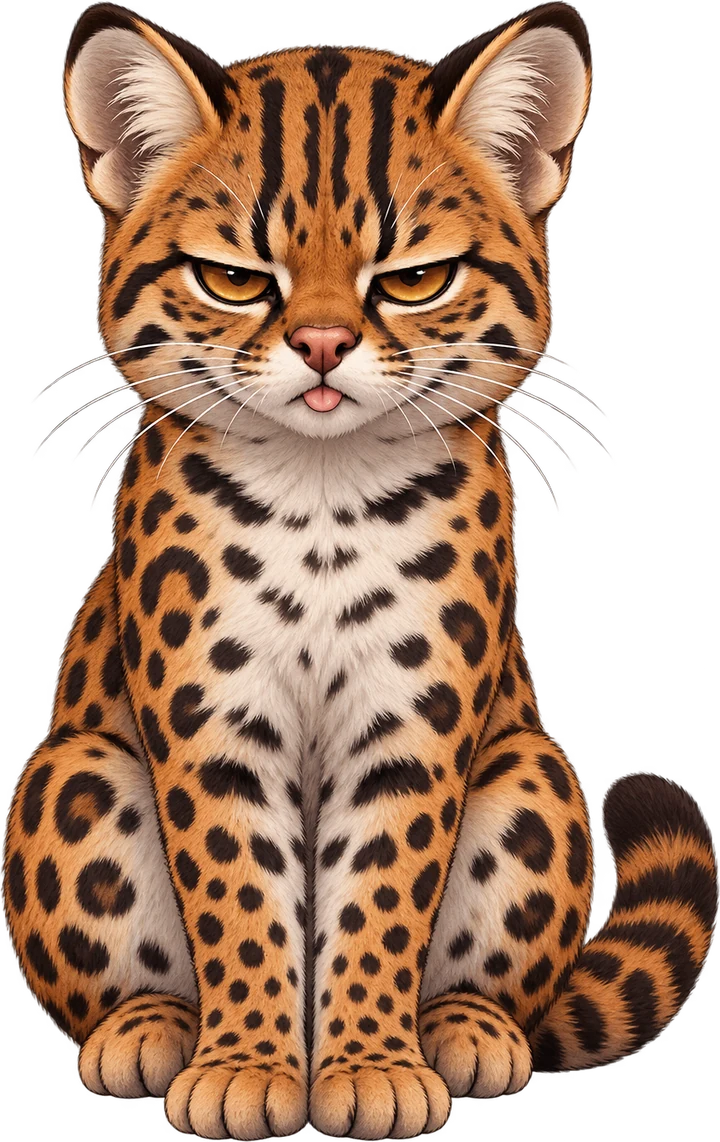
The first new wild cat species described in more than 100 years. In September 2026 an international team published a study in Current Biology formally naming Leopardus tilcayo, a small spotted cat from the Yungas cloud forests on the eastern slopes of the Bolivian Andes.
Quick facts
- Group: tiger cats (genus Leopardus), South America's small spotted wild cats
- Size: about 45 cm (18 in) head-to-body and roughly 1.3 kg (3 lb) — smaller than a house cat
- Look: rust-orange coat with large leopard-like rosettes, two dark stripes down the forehead, a long slender tail and a muted fur colour
- Home: Yungas cloud forest, Bolivia, in the Andes–Amazon transition zone
- Lineage: DNA suggests it split from its closest tiger-cat relative around 1.4 million years ago
A discovery by chance
Around 2017 a local family handed a small spotted cat to the Senda Verde Animal Refuge in the Yungas. Wild-cat conservationist and National Geographic Explorer Paola Nogales Ascarrunz met him while volunteering there and noticed he did not match any known tiger cat. Genetic analysis of 38 cats — including 26 tiger cats — led by Nogales Ascarrunz, Jonas Lescroart (University of Antwerp) and Eduardo Eizirik (PUCRS, Brazil) showed the tiger cats are at least five distinct species, one of them entirely new.
That ten-year-old male is still the only known individual of the species. Researchers are now placing camera traps across the Yungas to find tilcayos in the wild, which are easily mistaken for oncillas or margays.
Why "tilcayo"?
"Tilcayo" is the name local communities already used for the cat. The scientists kept it to honour that ancestral knowledge and the communities' connection to the animal.
Why it matters
Finding a new mammal is rare; a new cat is rarer still. The team hopes the description drives conservation of the Yungas forests, one of the least-studied and most species-rich regions of the Neotropics.
Sources
Photos of the real cat: Fernando Faciole / National Geographic. This game's artwork is an original illustration inspired by them.